
Concrete Cleaning
Surface-specific cleaning for concrete surfaces such as patios, walkways, and pads.
Starting at $149
Our Process
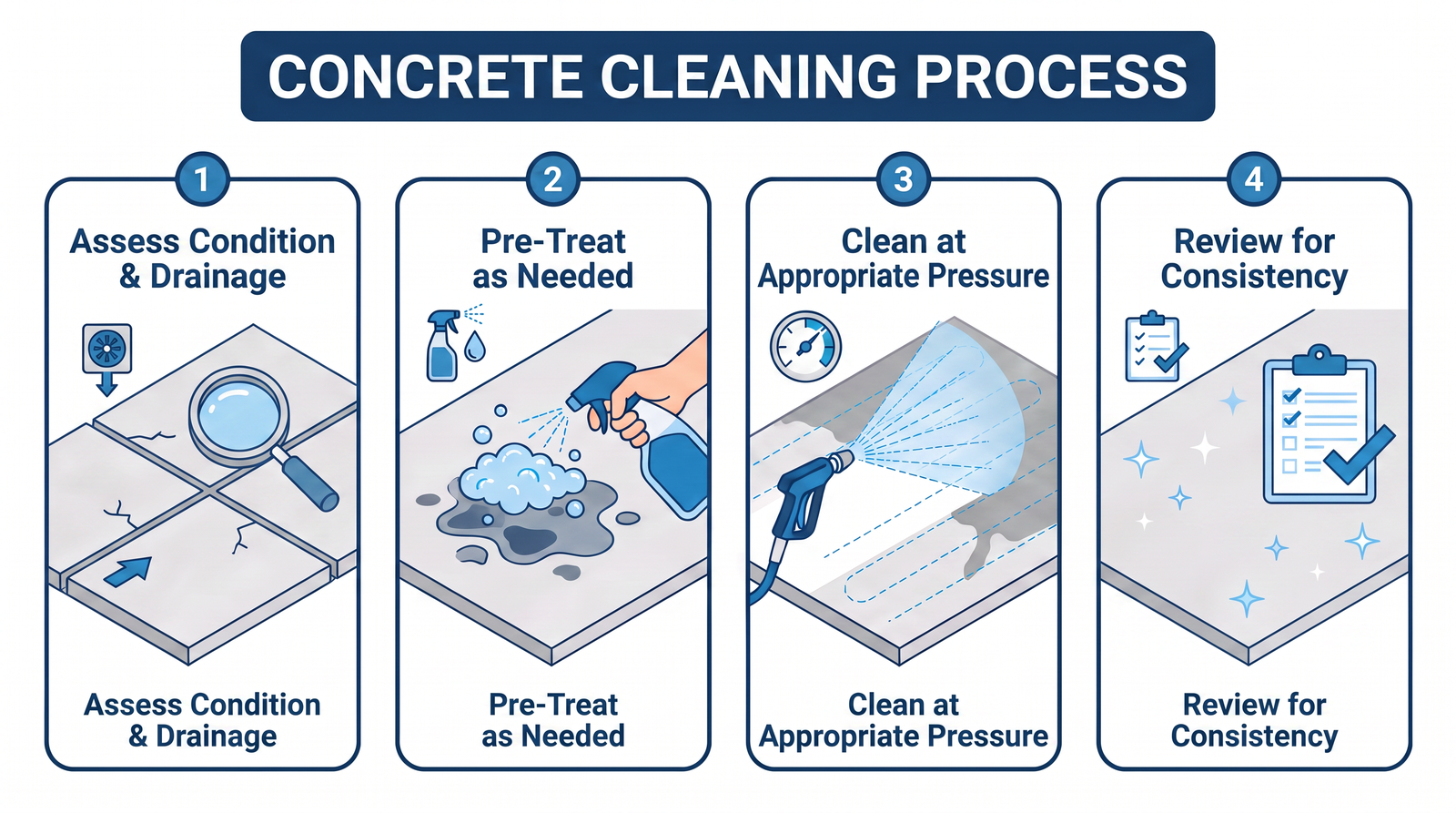
1. Assess Condition & Drainage. We assess the concrete's condition, joints, and drainage before starting.
2. Pre-Treat as Needed. Applicable buildup is pre-treated as needed.
3. Clean at Appropriate Pressure. We clean with pressure appropriate to the surface.
4. Review for Consistency. We review the result for a consistent finish.
Common Questions
What is the difference between soft washing and pressure washing?
Soft washing uses low pressure and surface-appropriate cleaning solutions for delicate materials such as many roofs and siding types. Pressure washing is generally reserved for durable hard surfaces, such as applicable concrete. SurfaceWorks ProWash selects the method based on the material, condition, and project scope.
Can you remove rust or oil stains?
SurfaceWorks ProWash offers targeted treatment for applicable rust and oil or vehicle-fluid staining. Results depend on stain age, material condition, surface porosity, and prior treatment attempts.
Can you get oil spots and tire marks off my driveway?
Oil, transmission fluid, and tire marking are treated as their own step, with a targeted pre-treatment applied to those spots before the concrete is cleaned in passes. Fresh surface oil usually comes up well, while fluid that has soaked deep into older, porous concrete tends to lighten rather than disappear. We look at stain age, how porous the slab is, and whether anything has been applied to it before, then tell you what to expect before we start.
How do you manage work areas and runoff?
Every project begins with a site-specific plan. For commercial and vehicle-heavy properties, we review drainage, nearby storm drains, access, operating hours, containment needs, and wastewater-recovery requirements before service begins.
Will pressure washing remove that chalky residue or fix oxidized siding?
No. Washing removes dirt, pollen, and organic growth sitting on the siding, but oxidation is the siding's own surface layer breaking down, not something sitting on top of it. On siding that's already chalked unevenly, an aggressive wash can lift some of that loose surface film and not the rest, leaving it looking blotchier than before. Our standard wash uses a controlled, low-pressure approach so it cleans evenly without making existing oxidation worse. Restoring color under the chalk is a separate, optional treatment we offer on request.
Learn More — what siding oxidation is and why pressure washing won't fix it
Do you clean gas station forecourts and pump islands?
Yes. Convenience-store approaches, forecourt-adjacent concrete, pump islands, dispenser surrounds, bollards, and columns are cleaned with a site-specific plan. We inspect for active leaks or fuel-related concerns, coordinate lane or pump access, dry-prep the area, protect storm drains, and use containment and wastewater recovery around drains.
How long do the results last?
How long results last depends on the surface, sun and shade exposure, tree cover, drainage, and local weather, so we don't promise a fixed timeframe. Shaded, tree-covered roofs and siding typically show regrowth sooner than sun-exposed surfaces, and concrete varies with traffic and moisture. Concrete that is sealed after cleaning stays protected longer — up to about 3 years depending on traffic and exposure — which is why we offer sealing as a follow-up option. Many customers schedule a recurring or annual cleaning to stay ahead of buildup.
Do you clean paver and stamped-concrete patios?
Yes. Patios are cleaned at a pressure matched to the material, which for pavers and stamped or decorative concrete means a gentler approach than a plain utility slab. On pavers we work in controlled passes to limit how much joint sand is disturbed, and we tell you if joints will need re-sanding afterward. Sealing is available as a follow-up once the surface is clean and dry.
Can brick and masonry be cleaned without damaging the mortar?
Yes, when the pressure is kept off it. Brick, block, and stone are cleaned with a low-pressure application and a solution appropriate to masonry, because aged or soft mortar joints erode under pressure that modern concrete shrugs off. We check joint condition, prior coatings or paint, and window and door openings first, and test an inconspicuous area when the material is uncertain. Where joints are already failing, we tell you that cleaning will reveal it rather than hide it.
Can faded color on oxidized siding be brought back?
Often yes, as an optional treatment separate from a standard wash. A house wash removes the dirt and organic growth sitting on the siding; restoring color means treating the oxidized surface layer itself, which is a different product and a different process. How much comes back depends on how far the oxidation has progressed and how evenly the panel has chalked, and heavily degraded siding can improve without returning to its original color. We look at the siding and tell you what is realistic before you commit to it.
Learn More — what siding oxidation is and why pressure washing won't fix it
More questions answered on the full FAQ page.