Exterior Surface Cleaning
A custom service for exterior areas beyond a standard category, such as stucco or brick.
Starting at $149
Our Process
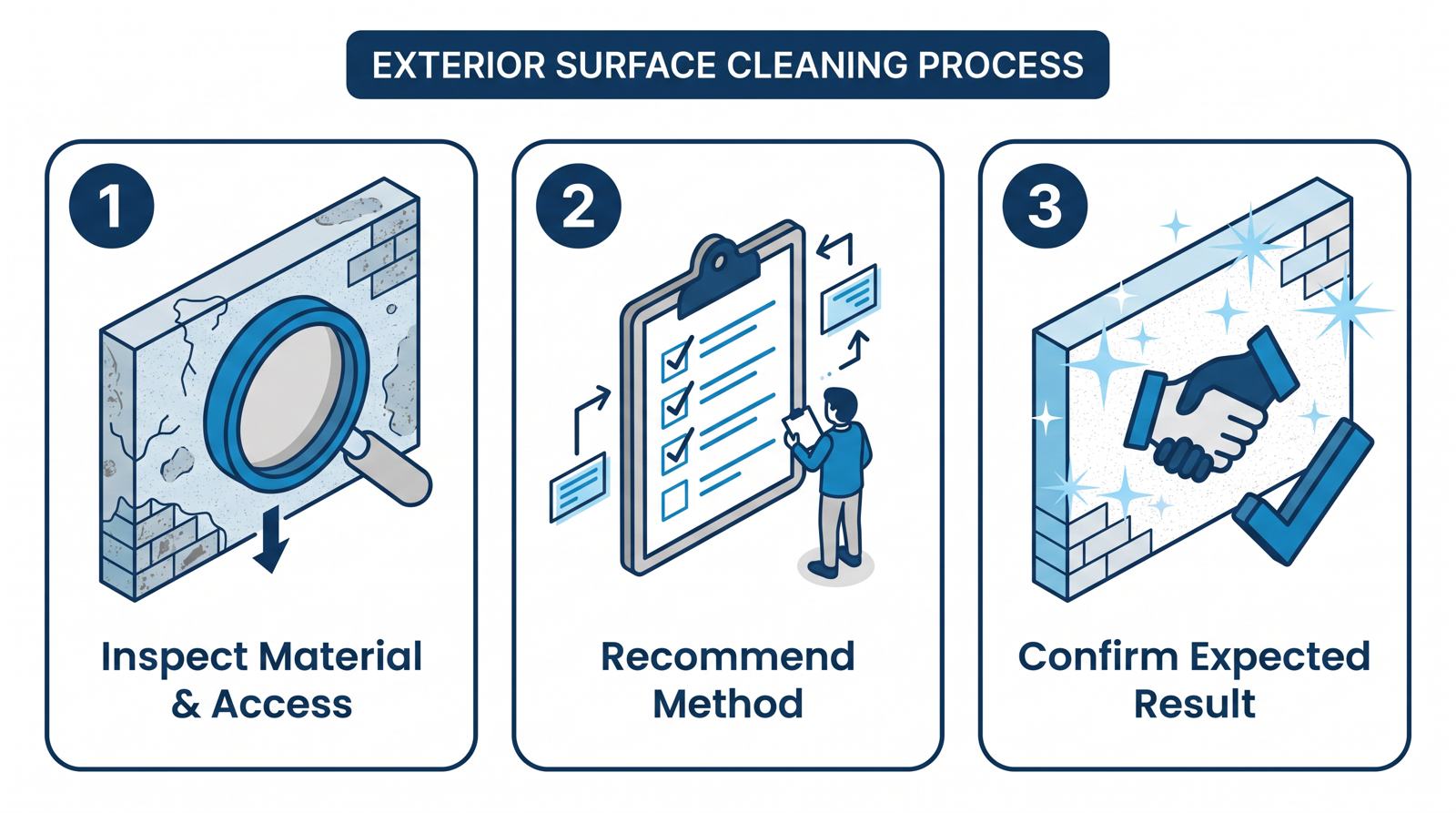
1. Inspect Material & Access. We inspect the material, access, condition, and drainage before recommending anything.
2. Recommend Method. We recommend the appropriate method and preparation steps based on that assessment.
3. Confirm Expected Result. We confirm the expected result with you before work begins.
Common Questions
Can brick and masonry be cleaned without damaging the mortar?
Yes, when the pressure is kept off it. Brick, block, and stone are cleaned with a low-pressure application and a solution appropriate to masonry, because aged or soft mortar joints erode under pressure that modern concrete shrugs off. We check joint condition, prior coatings or paint, and window and door openings first, and test an inconspicuous area when the material is uncertain. Where joints are already failing, we tell you that cleaning will reveal it rather than hide it.
Can you clean older brick buildings and storefronts in downtown Massillon?
Yes. Older brick and mortar is cleaned at low pressure with a solution appropriate to masonry, because aged joints and softer historic brick erode under pressure that plain modern concrete tolerates. We check joints, prior coatings or paint, and window and door openings before choosing a method, and test an inconspicuous area when the material is uncertain. Storefront approaches, entry pads, and sidewalks are usually cleaned during the same visit so the whole frontage matches.
I own a home in a historic district. How do you clean it without harming original materials?
Historic exteriors get the gentlest method that will do the job: low-pressure soft washing, solutions matched to the material, and a test in an inconspicuous area before committing to an approach. Original brick, aged mortar, wood clapboard, painted trim, and old glazing all fail under pressure that modern vinyl shrugs off, so pressure is not the tool. We inspect for failing paint, open joints, and loose material first and tell you what we would leave alone. Districts like these are part of our regular work in Canton’s Ridgewood area, Medina, Wooster, and Mansfield.
My historic district has appearance standards. Do you work within those?
Yes. Where a district or review commission sets appearance standards, the safe path is cleaning that removes soiling and organic growth without altering the material or its finish, which is what soft washing is for. We do not sandblast, strip, or apply coatings to a historic facade, and we don’t treat a cleaning as an opportunity to change how a building looks. Confirm any approval requirement with your local commission before scheduling, and we can provide a written scope stating exactly what will be cleaned and by what method so you have something to submit.
What is the difference between soft washing and pressure washing?
Soft washing uses low pressure and surface-appropriate cleaning solutions for delicate materials such as many roofs and siding types. Pressure washing is generally reserved for durable hard surfaces, such as applicable concrete. SurfaceWorks ProWash selects the method based on the material, condition, and project scope.
Will pressure washing remove that chalky residue or fix oxidized siding?
No. Washing removes dirt, pollen, and organic growth sitting on the siding, but oxidation is the siding's own surface layer breaking down, not something sitting on top of it. On siding that's already chalked unevenly, an aggressive wash can lift some of that loose surface film and not the rest, leaving it looking blotchier than before. Our standard wash uses a controlled, low-pressure approach so it cleans evenly without making existing oxidation worse. Restoring color under the chalk is a separate, optional treatment we offer on request.
Learn More — what siding oxidation is and why pressure washing won't fix it
Can faded color on oxidized siding be brought back?
Often yes, as an optional treatment separate from a standard wash. A house wash removes the dirt and organic growth sitting on the siding; restoring color means treating the oxidized surface layer itself, which is a different product and a different process. How much comes back depends on how far the oxidation has progressed and how evenly the panel has chalked, and heavily degraded siding can improve without returning to its original color. We look at the siding and tell you what is realistic before you commit to it.
Learn More — what siding oxidation is and why pressure washing won't fix it
What happens if I’m not satisfied with a spot after you leave?
Tell us right away and we come back and look at it. If something inside the agreed scope was missed or came out uneven, we return and address it. If the marking is something cleaning was never going to remove — a deeply absorbed stain, etching, or damage that was hidden under the dirt — we explain what it actually is instead of washing the same area harder and risking the surface. We try to flag those areas during the estimate so expectations are set before the first pass.
How long will the work take?
Most single-family house washes, driveways, and patios are finished in a few hours on a single visit. Roof soft washing, larger homes, several surfaces at once, or heavy staining that needs pre-treatment and dwell time take longer, and commercial sites are worked in sections around operating hours. You get a realistic time window with the estimate so you can plan access, parking, and vehicles.
My Alliance home is older, with painted wood trim and porch columns. Can it still be washed?
Yes — older homes with painted wood, porch columns, and mixed materials are exactly why soft washing exists, since high pressure damages aging paint and wood. We inspect paint condition, trim, glazing, and any loose or failing material first, and we tell you where washing would lift paint that is already letting go rather than doing it and handing you the result. Porches, steps, and entry concrete are commonly cleaned in the same visit as the house.
More questions answered on the full FAQ page.