
Siding Cleaning
Soft wash house washing for 1-story homes. Includes gutter, downspout, soffit and fascia cleaning.
Starting at $149
Our Process
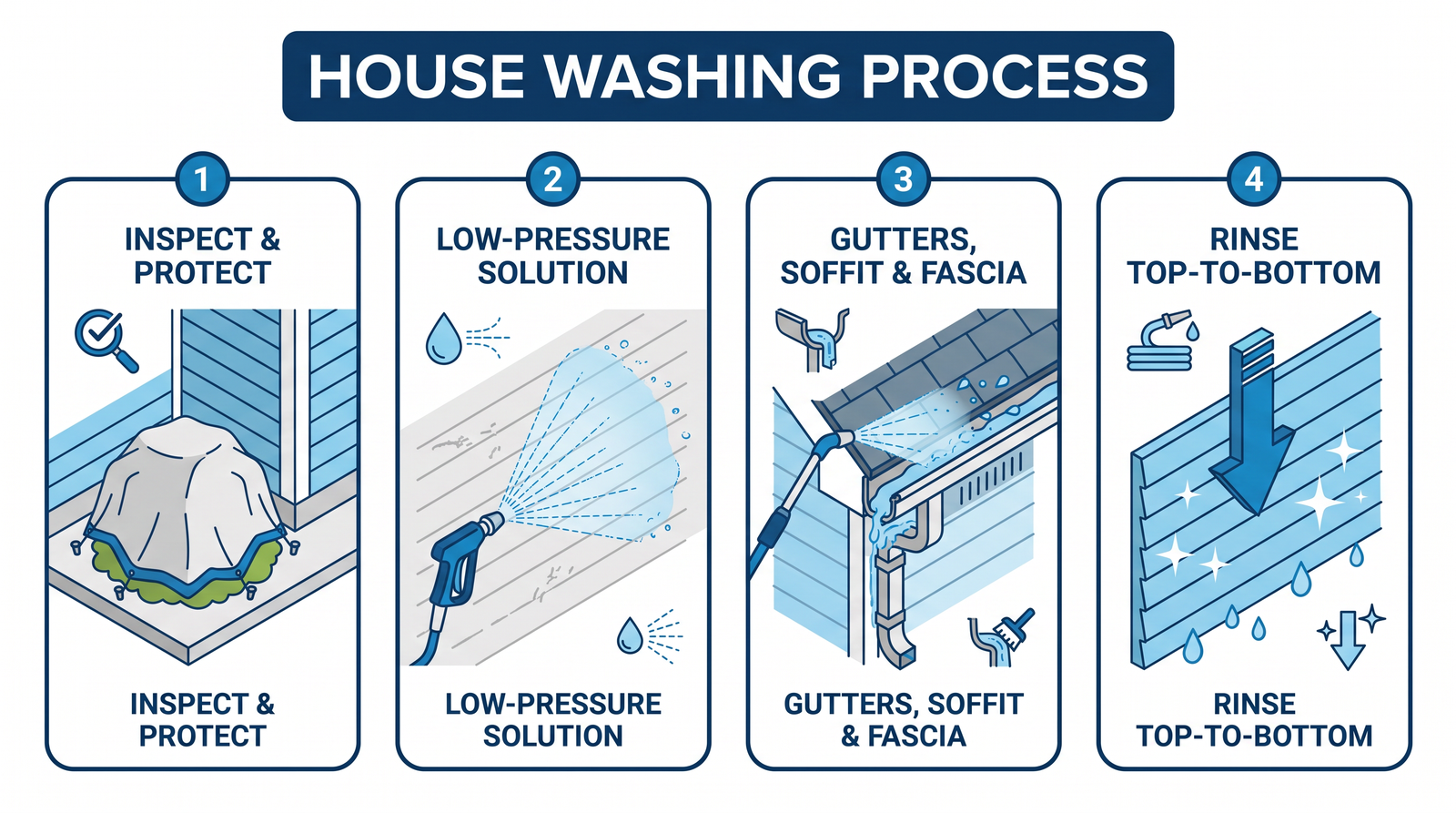
1. Identify Material & Problem Areas. We identify the siding material and the specific problem areas before starting.
2. Protect & Apply. We protect nearby plants and fixtures, then use a controlled low-pressure application.
3. Gutters, Downspouts, Soffit & Fascia. Gutters and downspouts are cleared and cleaned, and soffit and fascia are washed.
4. Top-to-Bottom Rinse. We rinse from top to bottom for an even result.
Common Questions
Will pressure washing remove that chalky residue or fix oxidized siding?
No. Washing removes dirt, pollen, and organic growth sitting on the siding, but oxidation is the siding's own surface layer breaking down, not something sitting on top of it. On siding that's already chalked unevenly, an aggressive wash can lift some of that loose surface film and not the rest, leaving it looking blotchier than before. Our standard wash uses a controlled, low-pressure approach so it cleans evenly without making existing oxidation worse. Restoring color under the chalk is a separate, optional treatment we offer on request.
Learn More — what siding oxidation is and why pressure washing won't fix it
Can faded color on oxidized siding be brought back?
Often yes, as an optional treatment separate from a standard wash. A house wash removes the dirt and organic growth sitting on the siding; restoring color means treating the oxidized surface layer itself, which is a different product and a different process. How much comes back depends on how far the oxidation has progressed and how evenly the panel has chalked, and heavily degraded siding can improve without returning to its original color. We look at the siding and tell you what is realistic before you commit to it.
Learn More — what siding oxidation is and why pressure washing won't fix it
What is the difference between soft washing and pressure washing?
Soft washing uses low pressure and surface-appropriate cleaning solutions for delicate materials such as many roofs and siding types. Pressure washing is generally reserved for durable hard surfaces, such as applicable concrete. SurfaceWorks ProWash selects the method based on the material, condition, and project scope.
Why does my siding have a chalky white residue on it?
That's oxidation, not dirt. Vinyl siding is made with pigment and UV-resistant additives that slowly break down under years of sun exposure, and the fine powdery film left behind is the byproduct of that breakdown. It's a normal part of how siding ages, most visible on sun-exposed and darker-colored siding, and isn't a sign of a problem with the material or a prior cleaning.
Learn More — what siding oxidation is and why pressure washing won't fix it
Will soft washing damage my roof shingles or siding?
Soft washing uses low pressure and a solution matched to the material, which is why it is the recommended method for shingles, painted wood, vinyl, and other surfaces that high pressure can damage. Concentration, dwell time, and rinse approach are adjusted to the surface and its condition rather than applied the same way everywhere.
How long do the results last?
How long results last depends on the surface, sun and shade exposure, tree cover, drainage, and local weather, so we don't promise a fixed timeframe. Shaded, tree-covered roofs and siding typically show regrowth sooner than sun-exposed surfaces, and concrete varies with traffic and moisture. Concrete that is sealed after cleaning stays protected longer — up to about 3 years depending on traffic and exposure — which is why we offer sealing as a follow-up option. Many customers schedule a recurring or annual cleaning to stay ahead of buildup.
Is gutter cleaning included with a house wash or roof cleaning?
Yes. House washing, siding cleaning, and roof soft washing all include clearing and cleaning the gutters and downspouts, and house and siding washes also cover soffit and fascia. That matters because debris-packed gutters hold moisture against the fascia and feed the same organic growth we just removed. If gutters are the only thing you need cleared, we can quote that on its own.
Will my windows be clean after a house wash?
A house wash rinses glass, frames, and sills as part of washing the walls, so windows generally look better afterward — but it is not the same as a dedicated window cleaning, and spotting or water marks can remain as the glass dries. We rinse carefully and keep overspray out of open vents, seals, and entry openings. If spot-free glass matters to you, plan on a separate window cleaning after the wash.
Can you wash a two-story or three-story house?
Yes. Upper stories are washed from the ground with low-pressure soft wash equipment that carries the solution up to the surface, which is safer for the house and for us than working a whole elevation off ladders. Height, roof pitch, landscaping, and access are all reviewed during the estimate because they change the plan and the time on site. If part of a wall genuinely cannot be reached safely, we say so before quoting rather than after.
Can brick and masonry be cleaned without damaging the mortar?
Yes, when the pressure is kept off it. Brick, block, and stone are cleaned with a low-pressure application and a solution appropriate to masonry, because aged or soft mortar joints erode under pressure that modern concrete shrugs off. We check joint condition, prior coatings or paint, and window and door openings first, and test an inconspicuous area when the material is uncertain. Where joints are already failing, we tell you that cleaning will reveal it rather than hide it.
More questions answered on the full FAQ page.